
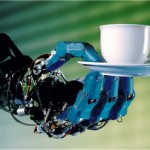
 The interaction between people and robots is at the heart of much research in the world. In Europe, the project meets Phriends laboratories whose goal is to create humanoid robots that can coexist safely with humans. And it’s not so easy …
It took several years of research so that we can play with the Light Weight Robot (LWR), a simple robotic arm. Today, the German researchers who have developed at the Institute of Robotics of mechatronics, depending on the DLR (the national center for aeronautics and space research in Germany) are the third version. Far away, at the University of Pisa, Italy, the group of robotics Piaggio Center for Robotics and bio-engineering, conducted by Antonio Bicchi, works on the same subject. These researchers have recently demonstrated the second version of their VSA (Variable Stiffness Actuator).
Both teams are part of a European project funded over three years ending in September 2009, baptized Phriends (Physical Human-Robot Interaction Dependability and Safety). The objective is to develop a reliable technology to make robots safe apes, that is to say, without danger to human beings around them. The writer Isaac Azimov, who had devised the laws of robotics, including stating that a robot must never hurt a human being, would be much appreciated.
The safety does not come naturally for devices equipped with powerful engines, able to move, to make movements of large amplitudes, lifting weights and generally made of a metal skeleton. Laches in life everyday and its thousand snares, these robots can not just say “oh sorry” when their arms have killed a human collaborator.
Consider the risks from the design of the robot
The measures to be taken at the time of conception for all areas, the structure of the robot itself, its coating, sensors, cameras, but also software controlling everything, including consideration of their crash possible. “The traditional approach is to design and build the robots in the context of a specific task,” said Antonio Bicchi. Those developed under Phriends be inherently safe because the security is guaranteed by their physical structure and not by external sensors or algorithms that can fail. ”
For example, the arm is operated by VSA engine antagonists, producing opposite movements. It also works well as muscle control of a member in an animal. In the LWR arm of the German team of DLR, the sensors are integrated and installed at each joint. The system locates so easily shock, even minimal.
The weight, or rather the mass, also contributes to the danger. Plus it is lightweight, less the robot will risk hurting his family. Capable of carrying a load of 15 kg, arm LWR weighs only 13.5 kilograms. With 7 degrees of freedom (like a human arm), it can perform its movements in volumes smaller than the conventional industrial robots, in which the degrees of freedom are limited to the minimum necessary for cost reasons.
With its attached fiber carbon, network data exchange internal fiber optic sensors and multiple arm LWR will never be a good model for industrial robotics. But the work of the project will Phriends however necessary to develop robots capable of apes engage in physical interactions with humans, or Phiri (physical human-robot interaction), a question that hangs today roboticists.