
AUBURN HILLS, Mich., June 7, 2004 – Robotic Production Technology (RPT) will introduce a new robotic laser cutting system at its technical open house on June 22-24 at its Auburn Hills headquarters. Automotive interior trim manufacturers can witness this product in action, trimming a low pressure molded, textile covered interior trim product.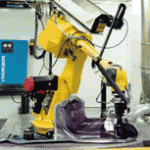
RPT is the exclusive provider of this system in the United States and Canada by partnering with Robot Technology, the developer of this revolutionary robotic laser cutting system based in Kleinostheim, Germany. Robot Technology chose RPT as its strategic partner due to RPT’s successful history in a wide variety of high accuracy, path intensive robotic trimming applications.
‘‘This revolutionary robotic laser cutting system brings the precision and unique cut quality of robotic laser cutting to the manufacturing factory floor of automotive interior trim suppliers, vacuum formers and paint film producers,’‘ said Chuck Russo, CEO of Robotic Production Technology. ‘‘It allows for trimming of some parts that cannot be processed with other trimming methods and has superior cut edge quality compared to trim presses.’‘
Robot Technology has installed more than 50 of these robotic laser cutting systems at European automotive interior trim suppliers, as well as a direct to the original equipment manufacturers.
The engineering ingenuity of this robotic laser cutting product makes it truly unique in the marketplace. The robotic system can incorporate a variety of sealed CO2 lasers – from 100 watts up to 500 watts while using only ‘‘4’‘ external optics to get the laser beam from the resonator to the focus lens. The system also features no external cables to the robotic wrist so the two wrist axes – #4 and #5 – are capable of rotating continuously. The system includes additional technical innovations and process specific features.
This new system answers the needs of manufacturers of low pressure-molded A, B and C pillars that match the cloth of vehicle headliners. It can be used to cut textile-based A, B and C pillars, paint films, soft trim products and other plastics and composite parts.
Since the beam delivery is through the arm of the robot rather than mounted on top of the robot, it boasts increased reliability and can maximize robot process speed. Due to the integrated design of beam delivery, power supply and cooling lines, downtime and maintenance are also reduced.