
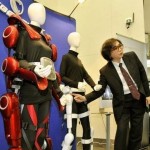
 As announced for several months Cyberdine, a Japanese company specializing in robotics, has started mass production of HAL, an exoskeleton powered muscle assistance. HAL (Hybrid Assistive Limb) has nothing to do with its namesake, featuring the famous film 2001 Space Odyssey. He really exists and, although less impressive, would certainly not odd to board the Explorer 1 described by Arthur C. Clarke.
The idea of the exoskeleton is not new. Others had already dreamed of an apparatus fitted with artificial limbs actuated by electric motors sufficiently light and compact, can be coated by a human being. The tenfold forces or make mobility for people with paralysis.
While the devices developed so far is heavy, bulky and inefficient, Japan’s Yoshiyuki Sankai, of Tsukuba University, has developed and developed HAL exoskeleton first to be marketed by the company Cyberdyne.
The first model, called HAL-3, was not present as the lower body and proved quite cumbersome. Used as a test, it then allowed the completion of the first prototype of HAL-5, equipped with arms and legs much lighter. On April 16, 2008 began building a factory for the production of the final model combining all the qualities necessary for a marketing meeting code-named HAL-5B.
The first intelligent exoskeleton
With a size of 1.60 meters and a weight of 23 kg (including 15 kg for the part intended for walking), HAL-5B is powered by a battery of 100 volts which ensures an autonomy of 160 minutes continuous operation . The range of tasks he can do is extensive and includes daily gestures, such as walking, climbing or descending stairs, lifting a weight or lifting heavy objects.
The main innovation is the HAL in its two modes of operation, is controlled by the person to be autonomous.
Said mode control bio-cybernetics, HAL sees, using sensors located on the skin, low electricity flow emitted by the brain and for transmitting orders to move the muscles of the wearer. Routed to a microprocessor, such information helps HAL to determine the nature of the movement to generate, and its size and adequate power to spend. The system computer then embedded control units for operating motor joints of the apparatus, even before the real muscle of the user into action.
A second mode is said to be autonomous because it is based on information already stored in the memory of HAL. Each basic movement such as standing up from a chair, climb stairs, is divided into successive sequences forming a given action, linking with the corresponding movements. The database in which HAL can draw is not permanently fixed, but updated continuously based on the movements perceived by the sensors. Thus, a bad data, or even the failure of a sensor that often hinder an ongoing action, that HAL will continue independently.
Mass Production
Cyberdine provides a first-time mass production of 500 units per year, which will be available for hire to hospitals, care centers or nursing homes or indoor sports. Takashi Hama, a senior official of the company, says it is studying the possibility of using HAL on construction sites where he could help transport and handling of loads.
Yoshiyuki Sankai has no objection, arguing that this technology is useful only if it is in the service of man, but denied any advance application for military purposes.