
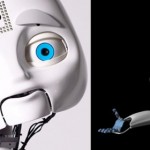
 The robot developed at the University of famous MIT in Boston (United States) was the star of the eleventh show of the Virtual Reality in Laval, in late April. Continue reading
Author Archives: admin
The robot will require learner does ethics?
 The proliferation of robots in everyday life inevitably raises issues related to ethics. This is also the theme of the conference s proposed June 20 by the next Forum for Science, Research and Society. Jean-Christophe Baillie, founder Gostai and speaker at the meeting, Continue reading
Stickybot, lizard biomimetic
 To make robots more autonomous and efficient, researchers sometimes draw the animal kingdom. Thus, it is by observing that the gecko engineer at Stanford University (USA) has designed the Stickybot, a robot climber. Continue reading
Big Dog at Big Brother
 Testing of chemical protective suits for the U.S. Army. That is the reason for the development of PETMAN, an anthropomorphic robot, big brother of the Big Dog quadruped, Continue reading
Android robots with brain
 This news comes from the hand of Asus, which will make a robot, EeeBot, using software like Android.
Android already is used in computers, phones, e-readers … which shows his great ability to adapt to any mobile system.
The project is still very early, but the proper implementation of Android (free software), with a good set of applications and hardware can make affordable robotics finally start to come into every home.
Hopefully the EeeBot has the same host that once had the EeePC.
Walking robot, is now moving over rough terrain
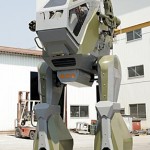 (NC & T) The so-called RunBot (Robot Corridor), lives up to its name, since it has the world record in speed walking for dynamic machines. Now its inventors have expanded its repertoire. With a special infrared eye can detect a slope on its path and adjust its gait on the go. Just like humans, leans forward slightly and uses shorter steps. You can learn this behavior in only a few trials.
The robot’s ability to change abruptly from one gait to another, is due to the hierarchical organization of control of their movements. In this respect, it resembles the control we possess humans, and can be taken as a human model. In the lower hierarchical levels, the movement is based on reflexes driven by peripheral sensors. The control circuits ensure that joints are not taken to the limit or that the next step begins only when the foot touches the ground.
Only when progress needs to be adapted, higher centers of the organization take control, a process activated by the human brain, or, if the robot, by its infrared eye leading to a simpler neural network. Due to the hierarchical organization, of the progress can be achieved by changing only some parameters. Other factors will be automatically tuned through the regular circuits.
In its first effort to climb a slope, RunBot will fall back, as they still have not learned to react to its visual input with a change in your gait. But like children, RunBot learns from its failures, which leads to a strengthening of the contact between the eye and the control modules of their movements. Only when these connections are established, step length and posture of the body are controlled by the visually induced signal. The slope is steeper, more pronounced will be the adaptation of the gait of RunBot.
Khatib’s project is one aspect of Project Honda Humanoid Robot
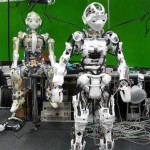 (NC & T) Humanoid robots today can walk, but can not interact with the world. Khatib and his collaborators are working to develop robots with the capability to physically touch, push and move objects. Continue reading
Humanoid Robot
 Rh1 The robot is the second robot is in Europe, is about 1.50 meters, is capable of walking in different environments such as outdoors or in an enclosed area. Continue reading
Spider Robot Kit
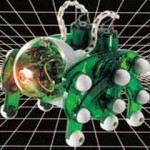 “Cool” just got even cooler with the invention of Spider III, the third generation in the quest to offer the most advanced design and technology available. Continue reading
Hyper Line Tracker Robot Kit
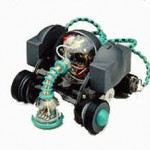 This cyber bug has a line tracking system and it is fortified with a multitude of sensors. Phototransistors enable it to detect a black line, and tracking memory allows it to memorize its last track of the black line. Continue reading