 Description:
- 20 degree-of-freedom humanoid robot comes assembled and ready to use
- Controlled using a wireless 2.4GHz Playstation-style remote
- Includes a triple axis accelerometer
- Rechargeable Lithium Polymer battery pack provides excellent performance
- No programming necessary, but can be interfaced with a PC for advanced motion editing
The Futaba RBT-1 Humanoid Robot Ready to Walk needs only one more component to be complete: You to give the orders. Use the included, Playstation-style controller to execute pre-programmed routines or those you program yourself with the supplied Motion Editor for your Windows PC. The robot’s 20 servo motors, four more than similar humanoid robots, are directed by FASST 2.4GHz radio signals rather than “TV remote” IR technology. The electronics for its flexible 16-channel operation and a rechargeable, high-capacity, 7.4V Lithium Polymer battery, are located in the torso for easy access. LED “eyes” add to the humanoid appearance and a self-righting function makes sure Futaba’s robot never lays down on the job.
Graphical Motion Editor software :
Modify existing motion sequences or create your own with this very user friendly motion editing software. Change servo positions using the text box, increment/decrement arrows or by manipulation the joints in the 3D rendered view.
Overview:
- 20 degree-of-freedom humanoid robot comes assembled and ready to use
- Controlled using a wireless 2.4GHz Playstation-style remote
- Includes a triple axis accelerometer
- Rechargeable Lithium Polymer battery pack provides excellent performance
- No programming necessary, but can be interfaced with a PC for advanced motion editing


 Animal-like robots are playing an increasingly important role as a link between the worlds of biology and engineering. The new, multidisciplinary field of biorobotics provides tools for biologists studying animal behavior and testbeds for the study and evaluation of biological algorithms for potential engineering applications. This book focuses on the role of robots as tools for biologists.
  Honda’s Asimo robot conducts the Detroit Symphony Orchestra. Robots are increasingly becoming less whimsical and more practical. Photographer: Paul Sancya/AP.In an age when multi-skilling is at a premium, Motoman may prove to be the model employee. When he’s not spot-welding on a car production line, he’s flipping pancakes – with not a drop of spilled batter in sight – and can even be called on to perform routine blood tests.Motoman is one of hundreds of cutting-edge robots exhibited during the past week at the industry’s biennial showcase in Tokyo.
 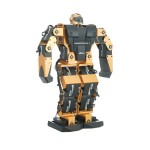 Hitec Robotics is proud to announce ROBONOVA-I. This exciting new humanoid robot offers educators, students and robotic hobbyists a complete robot package. The stable ROBONOVA-I can walk, run, do flips, cartwheels, dance moves and once programmed, is ready to compete in any Robo One Class “J” competition. Available two ways: as a kit, so you can enjoy building your robot yourself; or as a pre-assembled, “RTW” (Ready to Walk) robot.
  An upper arm portion and a lower arm portion are connected to each other by a substantially cylindrical elbow joint, and are bendable between an extended position in which they are extended into a substantially straight line and a bent position in which they are bent forwards from the extended position. The position of an axis of the elbow joint is offset forwards from the center of the width of the upper and lower arm portions, and slants inclined toward the elbow joint are formed on rear surfaces of the upper and lower arm portions connected to the elbow joint.
  Robotics4you is Germany’s first Roboterfachgeschaft with fascinating products on the topics of artificial intelligence robot technology now available for home users! The product range includes lawnmower robot, robot vacuum cleaner (not only for households but also for the catering industry or for clinics, offices and so suitable!), School Robotics training, technical non-fiction, entertainment, hobby, toys and more.
 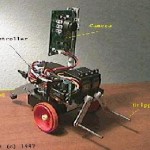 The CURI-4 platform was developed to investigate a layered behavioral control scheme for a mobile robot. CURI-4 is a small tethered robot equipped with a camera and a gripper for grasping objects. The tether carries data as well as power. The main robot components are 2 DC motors with gearboxes for the drive mechanism, 4 RC type servo motors, a small CCD camera and custom electronics for the motor control. The drive configuration is a tripod with 2 individually powered wheels and a static caster skid. One servo controls the pitch of the camera, 2 servos are used in the gripper, and the fourth servo is used for a leg that allows the robot to tilt raising and lowering the gripper. The camera can be positioned so that it can image it’s own gripper in order to see what it is picking up.
  Results of diagnostic tests on Spirit’s right-rear wheel on Sol 2109 (Dec. 8, 2009) continue to indicate a troubled wheel, which may leave the rover with only four operable wheels. The Sol 2109 plan included a check of the grind motor of Spirit’s rock abrasion tool (RAT) because it shares the same motor controller as the right-rear wheel. It also included rotor resistance tests on the right-rear motor at three temperatures using opposite voltage polarity from earlier tests, backward and forward commanded motion of the right-rear wheel, and a check of rotor resistance on all other operating wheels. The RAT motor appears okay, although a more exhaustive test will be tried later.