
 When parents give birth to a child, it would seem pretty ridiculous to expect that baby to immediately live and function as well as an adult. Yet our pursuit of humanoid robots does almost exactly that. We create automatons and try to train them to play and work like adults. As recently featured in Nature, the RobotCub project is rethinking that approach with iCub, a robot toddler. Funded by the European Continue reading
Author Archives: admin
Mechanical Design of Humanoids
 This paper presents the modeling and the design of the HYDROïD (HYdraulic anDROïD) humanoid robot. Our motivation related to the increase of understanding of human being locomotion and manipulation tasks achievement leads us to focus on the kinematical structure and the actuation aspects. The first part of this paper deals with a research work aimed to develop a new generation of three degrees of freedom (DOF) Continue reading
Design and Construction of a Humanoid Robot
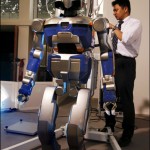 The desire to one day see a robot assistant cleaning our houses or walking our dogs has led to an increased interest into humanoid robotics research, and more specifically humanoid locomotion. At present, due to the high cost of robot platforms, there are only a small number of labs in the world conducting meaningful research on full sized humanoid robots. The existence of a low-cost humanoid platform would pave the way for greater involvement and development in the field of humanoid locomotion. This thesis describes the complete design and construction of an affordable humanoid robot platform for walking gait research, from the mechanical structure and actuator selection, right through to the required electronics and power storage implementation. The software required to operate the robot is discussed, from low-level feedback control through to high-level motion planning. The distributed nature of computational resources employed on this robot is outlined, along with the interaction with the robots sensors and actuators. A position based control methodology is proposed and implemented using traditional feedback loops on the robot. Control parameters were initially hand-tuned but subsequently improved via the implementation of an off-line evolutionary algorithm. Shortcomings in the mechanical design limited the success of this control scheme, with significant positional error observed in all joints whilst executing a walking gait. Actuator non-linearities as well as significant flexion in the underlying structure contributed to this positional error. To compensate, a series of adaptive control techniques were in turn amalgamated with the initial control loop in an attempt to learnthe system dynamics of the robot and provide adequate compensatory signals. These additional control schemes realised a slightly improved level of accuracy in simulation in the joint control space but not enough to compensate for the robots significant mechanical flexion. Extensive hand tuning of algorithm parameters and excessive memory requirements prevented their implementation on the real robot. This robot competed at two international robot competitions with acceptable results. In 2002, the robot competed in the Humanoid League of RoboCup02, in Fukuoka, Japan. The robot was the largest competing humanoid by a considerable margin and it achieved a ranking of 7th in both the freestyle and walking distance category, out of the ten humanoids competing. In 2005 the robot competed in the RoboCup competition, this time in Osaka, reaching the semi-finals of the penalty shootout for robots over 650 mm in height. The final robot was capable of rudimentary walking and other simple movements such as penalty shootout soccer skills, validating the structures ability to withstand the forces required to execute a walking gait.
Mechanical Design of Humanoid Robot Platform
 KHR-1 has been developed on the purpose of research about biped walking. It has 21 DOF without hands and head, which has 12 DOF in legs, 1 DOF in torso, and 8 DOF in arms. The objective of KHR-2 (41 DOF) was to develop the humanoid which can walk on the living-floor with human-like appearance and movement. KHR-3 has the purpose that it has more human-like features, movements and human-friendly character. Continue reading
designer Arnaud Deloustal
 Here is an interesting design concept from designer Arnaud Deloustal, the Oboe Humanoid Robot.The Oboe Humanoid Robot is designed to hang out with the elderly so that it can absorb, experiences, nowledge etc. Continue reading
Advance Humanoid Robot Design Awarded
 Eight universities have been granted a collective $2.5 million Partnerships for International Research and Education grant from the National Science Foundation. Five U.S. universities and three Korean universities make up the partnership. The grant is designed to be consumed over five years. The universities that make up the partnership are: Continue reading
Humanoid robot to teach software
 Yobotics Classrooms in Japan may soon welcome a new 4-foot-tall educational humanoid robot unveiled by Nippon Institute of Technology and other groups. It will be used to teach software programming and hardware engineering to students, but will also be demonstrated in Continue reading
Humanoid Robot Plays Soccer
 Your fears of world-dominating cyborgs and say hello to Hajime 33, an athletic robot who’s about as tall as Kobe Bryant. Granted, this bot plays soccer, not basketball (yet).Created by Hajime Sakamoto, Hajime 33 is the latest addition to Sakamoto’s fleet of humanoid robots. Powered by batteries, the robot is controlled with a PS3 controller, Continue reading
Humanoid robot Nao wants to be friends
 Aldebaran Robotics is showcasing the skills of its pint-size humanoid robot Nao ahead of its planned mass market release in about a year.Nao is definitely one of the coolest humanoids around that stands a chance of making it into households as a real product. Aldebaran envisions it as “an autonomous family companion.” Continue reading
Sony has developed small but remarkable robots
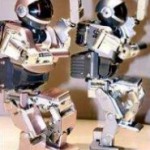
Like never before, technology can bring imagination to life. The question is what will we conceive? For decades, popular culture has been enthralled with the possibility of robots that act and look like humans. We are promised by film, fiction and television that humanoids will cook for us, clean for us, become our best friends, teach our children, and even fall in love with us. So where are they? The forerunners are here already. Recently, the media has covered a surprising number of new humanoid robots emerging on the commercial market. Like many new technologies, these early generations of commercially available humanoids are costly curiosities, useful for entertainment, but little else. Yet, in time, they will accomplish a wide variety of tasks in homes, battlefields, nuclear plants, government installations, factory floors, and even space stations.