
 A new doctor at the hospital. Well, more or less.
The male doctor is a robot that works with a joystick, has three wheels, a stethoscope and may be the solution to the shortage of doctors and nurses that affects hospitals in the nation. Chico (English acronym of Computer Intensive Care Attendant) allows physicians and nurses to virtually examine patients, they speak, have access to digitized medical records and, ideally, diagnose diseases but is far from the patient.
The robot’s face is a flat screen.
Not that Chico does the work of doctors, but facilitates their work supervising the patient. And when the doctor is next to the patient, can get a second opinion from a distance. Or if the doctor and patient speak different languages, Chico coordinated interpretation. “With the acute shortage of specialists in trauma and critical care, telemedicine is going to move,”said Dr. Jeffrey Augenstein, a professor of surgery and director of Ryder Trauma Center.” The advantage of such a thing is worth millions.”
The robot does not cost a penny to Jackson Memorial Hospital. The Army and the Jackson lease it reaps the benefits because the Army medical personnel are trained in this hospital before being deployed to Iraq and Afghanistan. Doctors at Jackson and Miller School of Medicine, University of Miami began using a male since last month on an experimental basis, although not yet fully operational. As the population ages and the shortage of specialized physicians is acute, medical videoconferencing robot could be the future.
“In the history of modern medicine to the patients we assessed seeing and talking to them. This would be a way to change that system,”said Augenstein.” We sat in this room [the robot] and have access to all information of no matter who is patient with us or across the world.” The robot of Jackson is one of a kind used in the trauma center, according to the creator of the device, In Touch Technologies, based in California. Four other Army hospitals – one in Seattle, two in Texas and one in Germany – but those hospitals are trauma centers.
Dozens of similar units, called RP-7 Remote Presence Robots are used in hospitals around the country to assess embolisms, heart attacks and critical care. Ryder Trauma Center at Jackson handles 4,000 cases a year.
The Army expects that robots allow access to specialists at the forefront of battle.”The Army has a shortage of surgeons … with a growing need in the battlefield … this can help,”said Dr. Donald Robinson, lieutenant colonel and chief of Army Training Center at Jackson.
Hospital officials say the robot is a great benefit to the population.
“What if someone is injured in Key West or in a rural county,” asks Augenstein. Answer: If the hospital has a broadband connection the robot can help doctors diagnose from Jackson if the patient should be transported to the trauma center. The robot was created by Dr. Yulun Wang, In Touch Technologies. This latest version of the preceding six.
Robots do not require regular maintenance but are permanently monitored every two minutes, technical service teams. “The robot informs its corresponding computer server when operating properly,”Wang
Some 25 doctors, surgeons and trauma center technicians have learned to use the robot. Dr. Antonio Martta Jr., Associate Professor of Surgery, is known as the most skilled operator of the robot, which sensors avoid colliding with people or objects. “For me it’s easy,”said Martta laughing.” Before I spent much time playing video games.”
The robot is new, but doctors say that the origin of its operation is not.
“All of us have practiced telemedicine, just not as advanced,”said Augenstein.”You get a call from another doctor, send a picture … we do this daily. We practice distance mentoring.” Doctors do not believe that robots replace them completely. “In the practice of medicine the doctor’s presence is necessary for human contact.”
 A mission to determine if robots, like spiders, they can build complex structures in space, will be launched in January 2006 according to ew Scientist magazine. The spider bots could build large structures from a “web” released from a larger spacecraft. The engineers behind the project plan to eventually construct colossal solar panels for satellites that will transmit solar energy back to Earth. The satellites could reflect and concentrate the sun’s rays on a power receiving station on Earth or perhaps in the form of microwaves.
 Rudy is the new employee Davis Medical Center, University of California. It measures 1.68 meters, weighs 90 kilos and is a robot. Its main function is to allow doctors to interact with post-operative patients without being present. The body of this ‘Robodoc’ consists of a camera, a television screen and microphone. Thanks to its structure, the physicians, patients and family members can see and hold a conversation.
 The big advantage of space robots is that they need neither food nor drink and can work in inhospitable conditions. More importantly, although expensive to design and produce, their loss is always preferable to an astronaut. In the edition of November 2004 ASTRA robots designed in the Space Research Laboratory of the Technical Center of ESA in the Netherlands attracted much attention.On Earth, robots often take repetitive tasks or when human health is jeopardized. They are used to assemble cars, deactivate bombs, weld pipes at the bottom of the sea and work in nuclear power plants, “says Gianfranco Visentin, Head of Automation Robotics Section at ESA ESTEC in the Netherlands.
 Facing the increasing number of medical students and the few units available for learning, a Mexican university began using robotic patients to train future doctors. The National Autonomous University of Mexico (UNAM) on Monday opened the “virtual hospital” world’s largest, in which students can practice from birth with a mannequin robot up a shot in the arm of a plastic baby.
 The personal attitude toward these artificial creatures and the very purpose of these is the study of the program entitled Living with robots and interactive companions (LIREC in ALARA), which have just jointly launch several European technology research centers.
 This approach applies the knowledge gained from the natural sciences (biology and ethology) and Artificial Life (neural networks, evolutionary techniques and dynamical systems) on real robots, to develop their own skills in close interaction with the environment and without human intervention.
 At least six fields of research today advanced robotics structure: one that relates the robot with its environment, the behavioral, cognitive, or developmental epigenetics, the evolutionary and biorrobótica. It’s a big field of interdisciplinary study that relies on the mechanical, electrical, electronics and informatics, as well as physical science, anatomy, psychology, biology, zoology and ethology, among others. The basis of this research is embodied Cognitive Science and the New AI. Its purpose: lighting intelligent and autonomous robots that reason, behave, evolve and act like people. By Sergio Moriello.multidisciplinary study, which relies largely on the engineering (mechanical, electrical, electronics and computers) and science (physics, anatomy, psychology, biology, zoology, ethology, etc.).. Refers to highly complex automated systems that have an articulated mechanical structure, governed by an electronic control system, and characteristics of autonomy, reliability, versatility and mobility.
 Researchers in robotics from the University of California at Davis have developed a control system which allows the robots to collect evidence suggesting that their leader is about to turn, predict where it will go and then follow him. “This is a fundamental problem in robotics,” says Sanjay Joshi, associate professor mechanical and aeronautical engineering at UC davis. Indeed, whether walking down the street, while driving on the highway or in many other situations, the man often collected deliberate signals and unconscious clues in order to predict what the others and act accordingly. The robots, however, more difficult to coordinate so, for example when the leader of a group turns a corner and disappears from the field of vision of its congeners. Studies in behavioral psychology have shown that a person is about to turn unconsciously a brief nod in the direction it is preparing to borrow so that others can follow.
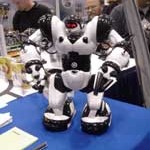 The robot exhibition held from October 21 to 23, 2004 in Santa Clara, the heart of Silicon Valley is always a good opportunity to take stock of a rapidly evolving sector. This exhibition, the largest of its kind, brings together the Convention Center of town all that is best in robots. Thousands of professionals and enthusiasts jostle for three days on the stands and conferences to identify trends and see the main news.