
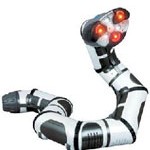
 The realization of robots inspired snake occupies a prominent place in robotics over the past decade. But it has hitherto been difficult to accurately reproduce the movements of the reptile. A skill that researchers SINTEF have managed to emulate a system composed of Aiko robot and a virtual double of the snake which allows experiments on computer. Unlike most of its predecessors, this snake does not need wheels to be able to move with ease. For if the recent addition facilitate the removal, by converting the twisting motion in a continuous slip, he moves better on smooth surfaces. But the interest is to use this type of machine in the affected areas. “In a collapsed building where there are lots of rubble, for example after an earthquake, a wheeled snake would probably be stuck,” says Aksel Transeth researcher at SINTEF.
A virtual double
A robot more versatile, more closely reproducing the twisting of the snake could he, pushing the obstacles he encounters, like stones. This new model is called Aiko, measuring 1.5 meters and is composed of segments of PVC tubes with motors connecting joints. It is capable of pushing objects that barrier in his path at 15 cm per second. Moreover, a virtual double of Aiko, which accurately reflects the movements and reactions of a snake in real life, will be used to guide system development. Thus, if this is not the first attempt to move obstacles to snake robot Aiko is the first to have a virtual double that simulates previously movement. However the research team qualifies: “It is easier to simulate on a computer than to build a robot and to experience in reality.”
Promising advances
It therefore remains difficult to construct a model of robot that accurately reproduced the movements of real reptile. It is still too complex to master perfectly the reflexes of robot and some segments of Aiko can interact with the ground or obstacles he encounters in different ways in different situations. For example, a segment can slide over an obstacle while another will try to climb over. To help achieve these movements, researchers have launched a program transcript of gestures algorithms to mathematically translate their observations. They also explore new ways to improve those movements. One of them is the integration of sensors.
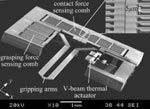 Robots at the nanoscale can already do some basic manipulation. But it remained difficult to control to enable them to perform more complex actions such as handling of nanoelectronic components or cells. To overcome this problem, a team of University of Toronto (Canada) announced having developed a pair of robotic grippers can move independently in the middle of a microscopic environment, without damaging the surrounding components. The principle is simple: these micro robots are endowed with the sense of touch. “The robots are equipped with load cells that allow them to perceive their environment through touch,” said L’Atelier Philippe Bidaud, director of the Institute for Intelligent Systems and Robotics (ISIR). “And therefore include data such as weight of an object, the resistance of a membrane,” says he.
 Jerome Damelincourt leader Store Robopolis, has agreed to give us his vision of robotics, he meets a world forever. At a time when Asimo serving coffee and talk to the caller, one wonders in what direction the robot moves. The Workshop – Hello Jerome Damelincourt. People come from afar to come and visit Robopolis. How did you get the idea to open a shop dedicated to robots? Jerome Damelincourt – In 2000, I decided to create the website vieartificielle.com. Before his success and public enthusiasm, I opened Robopolis in 2003. To mark the opening of the shop, I also created a website dedicated robopolis.com. It was a dream that I never let go.
 The Flame robot was already able to move through a process similar to that of a human being. A team of University of the Basque country now wants to give the droids ability to move independently and adapt to their environment. His robot Tartalo, has a navigation system allowing it to move freely in confined spaces such as apartments, even if it has not been scheduled for housing in particular. This is indeed able to adapt to changes in space. A camera positioned at eye level allows him to perceive its environment. The computer is equipped has been programmed to recognize four different areas: bedroom, corridor, lobby and no door. When placed in a new environment, he made several Featured order to identify and memorize the location of each piece.
 RYOBOT is my Rug-Warrior-based robot. It stands about 8 inches high, and is about 6 inches in diameter. It has two-motor differential drive, a 360 degree bump skirt, and the full complement of sensors from the Rug Warrior design. The logic is powered by 4 AA cells and the drive is powered by six rechargeable 2-volt D cells in two batteries of three each.
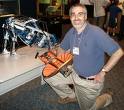 This robot is built using a 6-wheel motorized toy called the BOSS (Battery Operated Spin System) which was available at toy stores a few years ago for about $120. The unit included wheels, gear motors, batteries and charger. The plastic stuff was tossed and a wooden base was attached and multiple decks made from sheets of aluminum. The power electronics including the batteries and motor drivers are on the bottom deck, the computer is on the second deck and the sensors are on the top deck. The computer is a standard PC/XT motherboard which controls the 2 DC motors using the parallel printer port. Software resides on a 3.5″ floppy and automatically boots the robot program which was written in Quick-Basic V4.5. The software has the ability to read a joystick and record motions then play back the motions. This teach-and-repeat technique works well for short robot competitions where the task is well defined. Overall cost was about $450. Email questions to roger@robotics.com
 Robot arm commanded by a microcomputer.
The processor used is a onechip processor from Intel (80c196KB).
12 MHz, 32K RAM, 16K ROM.I use an IBM PC compatible computer to send command sequences via the serial port (LPT1)
to the 80c196KB.The 80c196KB transformes the command sequences to pulses which make the robot to move.
The PC program is a simulator. You can make a simulation and see how the robot will move.
The program language I used to program the 80c196KB and the PC was C.
I used Playwood and aluminium to build the robot.
The robot is commanded by four R/C servos (HITEC HS-300).
Specifications:
- A robot-arm commanded by a microcomputer.
- The microcomputer: 16Kb ROM, 32Kb RAM, 12MHz.
- The microprocessor in the microcomputer is a onechip processor made by Intel, 80C196KB.
- A program in a compatible IBM PC simulates the robot-arm's movement.
- The command-sequences are then sended to the micorcomputer via COM port.
- The microcomputer translates the commands and makes the robot to move.
- The robot: Is a four axes robot and has four R/C servos (HITEC HS300).
- One for the base, one for the choulder, one for elbow and
one for the gripper.
- Materials used to build the robot are Playwood and Aluminium.
Hardware required for the PC's program :
- A PC based on Intel 80386 or highter.
- SVGA graphic for GUI.
- MS_DOS as OP.
- Communication port (COM1 or COM2) for sending/taking data
to/from the robot.
Robot arm commanded by a microcomputer.
The processor used is a onechip processor from Intel (80c196KB).
12 MHz, 32K RAM, 16K ROM.I use an IBM PC compatible computer to send command sequences via the serial port (LPT1)
to the 80c196KB.The 80c196KB transformes the command sequences to pulses which make the robot to move.
The PC program is a simulator. You can make a simulation and see how the robot will move.
The program language I used to program the 80c196KB and the PC was C.
I used Playwood and aluminium to build the robot.
The robot is commanded by four R/C servos (HITEC HS-300).

Specifications:
- A robot-arm commanded by a microcomputer.
- The microcomputer: 16Kb ROM, 32Kb RAM, 12MHz.
- The microprocessor in the microcomputer is a onechip processor made by Intel, 80C196KB.
- A program in a compatible IBM PC simulates the robot-arm's movement.
- The command-sequences are then sended to the micorcomputer via COM port.
- The microcomputer translates the commands and makes the robot to move.
- The robot: Is a four axes robot and has four R/C servos (HITEC HS300).
- One for the base, one for the choulder, one for elbow and
  one for the gripper.
- Materials used to build the robot are Playwood and Aluminium.
Hardware required for the PC's program :
- A PC based on Intel 80386 or highter.
- SVGA graphic for GUI.
- MS_DOS as OP.
- Communication port (COM1 or COM2) for sending/taking data
to/from the robot. The experimental SCARA (Selective Compliance Assembly Robot Arm) Robot ressemblesan industrial robot, but is a lot smaller and less precise. The mechanics consist of one linear and three rotational axes, with the rotational axes oriented vertically,so that gravitation has no effect on these axes. The working space is 410mm indiameter and 128mm high, with an position accuracy of 0.5mm.
  Robot name: ROBBIE (Robot Obeying Bit by Bit Information in
interactive Environment)
Size : 4.4 feet
weight : 40 pounds
Power : 12 volts, 6 volts and 4.8 volts.
Time to build : one year and continuing
Cost : aprox. $1,000
GENERAL:
-This robot is controlled by a PC through a remote control connected
to a serial port.
-It uses 16 servos and 22 DC motors
-It has two arms, that can pick objects each consisting of 7 motors
-Quickcam is used for remote viewing.
-I have programmed it in Visual Basic.
-ROBBIE can navigate my whole house without any assistance.
-I have made my own electronic compass that is connected to the
controller's input. and much more...
FUNCTION:
ROBBIE can do my laundry, switch home lights on-and-off. It is a
security system for my house. It can hand me a glass of water. It
follows me arround. and much more...
PROBLEMS ENCOUNTED:
I learn while making my robot...
PARTS:
Most of the motors are from junk yard and rest from hobby centers.
I have used plastics for the body.
Robot name:  ROBBIE (Robot Obeying Bit by Bit Information in
             interactive Environment)
Size      :  4.4 feet
weight    :  40 pounds
Power     :  12 volts, 6 volts and 4.8 volts.
Time to build    : one year and continuing
Cost      :  aprox. $1,000

GENERAL:
-This robot is controlled by a PC through a remote control connected
 to a serial port.
-It uses 16 servos and 22 DC motors
-It has two arms, that can pick objects each consisting of 7 motors
-Quickcam is used for remote viewing.
-I have programmed it in Visual Basic.
-ROBBIE can navigate my whole house without any assistance.
-I have made my own electronic compass that is connected to the
 controller's input. and much more...

FUNCTION:
ROBBIE can do my laundry, switch home lights on-and-off.  It is a
security system for my house. It can hand me a glass of water.  It
follows me arround. and much more...

PROBLEMS ENCOUNTED:
I learn while making my robot...

PARTS:
Most of the motors are from junk yard and rest from hobby centers.
I have used plastics for the body. Trilobot mobile robot platform is used by educators and industry for a variety of tasks including research in artificial intelligence, navigation and security. Sensors include compass, tilt, light, temperature, ultrasonic ranging and bumpers. Programmed by the user’s laptop computer which communicates through the serial port using common programming languages such as C, Visual-Basic, Pascal and Prolog. High-speed radio modems are also available for communication to off-board computer systems.