
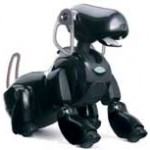
 Restructuring Plan requires Sony has announced the discontinuation of production of Aibo, the famous robot dog that can monitor your home when you’re not here to speak with a vocabulary of more than 1000 words and even for latest developments, to keep a blog! Launched in 1999, the Aibo adventure stops, lack of profitability, like that of QRIO, the humanoid robot from Sony, which has never been marketed. Continue reading
Tag Archives: humanoid robot
Bio-Robotics : Elastic Strip Framework
Most motion planning algorithms assume complete knowledge of the geometry of environment. Typically obstacles in the environment are assumed to be static or their motion is known as a function of time. To generate a motion, the algorithm performs a search in the configuration space of the robot, C.. Such a space encapsulates all legal, Cfree , and illegal, Cobs, configurations of the robot and the goal is to find a continuous path in Cfree connecting initial and final configurations. For robots with multiple degrees of freedom, the configuration space is extremely high-dimensional. To allow planning for environments with moving obstacles the configuration space must be further augmented by the dimension of time. Performing a search in such high-dimensional spaces is infeasible and people have in the past resorted to probabilistic and randomized approaches that confine the search space to a subset of all possible configurations. Continue reading
Tomorrow, the robots will include your thoughts
Designed to assist humans in their daily ungrateful, Japanese robots will not wait so ordered them aloud to rid the table to get to work: suffice it to think and to act.
Researchers from the Japanese car manufacturer Honda, designer of humanoid robot Asimo, developed a technology that allows a human to partially control the biped, or on other machines, simply by pensée.Leur device “commands brain” is based on a new method for analyzing the brain activity, carried out through a big computer with a headset wrapped with various sensors. Continue reading
The design of robots is not just about technology

The man-machine interface may be hampered by clichés that convey particular films. Engineers study the perception of robots to optimize the creation of future humanoid.
Help engineers to design robots that correspond to the end user. It is the goal pursued by the robotics Bill Smart and literature researcher Lara Bovilsky, both teachers at Washington University in St. Louis. They presented a workshop on how fictional robots are perceived by many in the RO-MAN conference 2008 held in Munich. The image of robots that carry into effect such films as Terminator or Matrix hinders the massive development of robots and especially the quality of interaction between man and machine. “Most people have never seen a robot of their lives. The only experience they have comes from movies or books,” said Bill Smart in New Scientist. This affects how they react to real robots. “People have a preconceived idea of how a humanoid should behave. If this is not the case, they may be confused.” Continue reading
IRT robot system research and development
 The University of Tokyo, “the graying of society and social support to people and the creation of IRT based” projects has been from 2006. In this project, IRT gradually established a platform promoting innovation, and social support to older people have fewer children and IRT scenario depicts the creation of the foundation. The platforms, robots, social support system, IRT research project creation based robotic system is composed of a platform, for the social needs of the graying of society, robotic devices, IRT control, IRT environment while practicing in a new technology platform for innovation. Continue reading
A humanoid robot to imitate human emotions-Videoconferencing
 Bristol, England – A team of scientists from the Robotics Laboratory of Bristol developed the first humanoid able to imitate the facial expressions and lip movements of a human observing.
Jules, it is called, is appointed as a head and neck but can instantly copy the movement faces of people he observes with video cameras and tiny electronic motors hidden under the skin of his face. It can crack a wide smile, grin, riding his forehead and “talk” with the software it is equipped, and that translates into real-time human expressions he observes through his eyes equipped with video cameras. Continue reading
Honda Asimo – First Stage
Reply
Honda has taken up a new challenge in mobility – the development of a two-legged humanoid robot that can walk.


Honda wants to create a partner for people, a new kind of robot that functions in society. In 2000 the humanoid robot ASIMO was born. ASIMO stands for Advanced Step in Innovative Mobility.
