 There are different kinds of robots, including humanoids which are for instance those who left us watching the movie “Robocop” or to deliver a more everyday example, the robot Asimo from Honda. As can be seen in the first graph of this article, the Asimo was changing as the technology of artificial intelligence was giving way to the opportunity to improve the conditions under which these machines could perform both basic functions like walking, lifting hands, moving his head, etc., up to complete much more complex operations such as jumping, walking, and say a few words.
The robot Asimo from Honda, which stands for A dvanced S tep in I nnovate Mo bility, has among its main features being built entirely in a way that can bend and do all the typical movements of human beings, through their embedding within overall system of a computer-brain which is controlled by remote control. This device also controls the charging party robot, so you can have more time for action without a massive waste of energy used for mobilization of the humanoid, thereby allowing an action which is much more controlled.
Asimo from Honda can walk at a speed of 3 km / h run twice, almost imitating the movements of a child who is just starting to take its first steps. The integrated system coordination Asimo similarly lets do simple tasks with their mechanical arms such as carrying trays to use small items like keys and even bend some things to organize them. To make a little reference to mobility, Asimo is also able to rotate, completing laps around its axis which is located in the ring.
A battery pack is charged to provide fuel for this likeable character, he’s an increasing feeling that occurs in public. The advantages that can provide the robot Asimo in the future are quite striking, for example, widespread service customer service in all types of organizations as being observed, the possibility of being used in rescue maneuvers, no doubt a valuable toy teaching in many kindergartens, as “virtual teacher” for new models of education and why not, the study of motion in bodies.

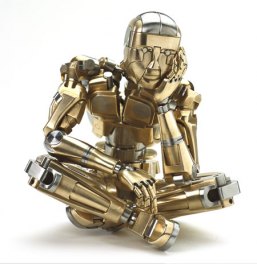 The Evolutionary Robotics (ER) is an area of autonomous robotics, in which drivers are developed through evolution robots using genetic algorithms.
 Hitachi Ltd. presented the second humanoid robot, named EMIEW2. The robot weighs 13 kilograms, can move on wheels and walk on two legs, also on his head, there are 14 microphones that can recognize the voice, even if three people are talking simultaneously.
  Welcome to the fashion show -. “The 8th Japan Fashion Week Tokyo once (JFW)” (organized by Japan Fashion Week Organization) that begins 23 days to show in Roppongi, Tokyo Midtown, held in Tokyo, a young designer, the humanoid robot “HRP – 4C “appeared, making his debut model.
  After winning the semi-final 3:0 against HWM (Villach, Austria), our robot Dynaped met the robot from CIT Brains (Japan) in the final of the TeenSize Dribble-an-Kick tournament. Dynaped dribbled the ball reliably across the field and kicked it strongly into the free goal corner. As a goalie,
  The humanoid robot Rh-0 (and its actualization Rh-1) is full size (1.3 m height, 21 DOF and about 50 kg weight) robot. The robot is equipped with two on-board CPUs and CAN bus communication system. Two batteries are also on-board which allows the 30 minutes of autonomy.
  The humanoid robot Rh-0 (and its actualization Rh-1) is full size (1.3 m height, 21 DOF and about 50 kg weight) robot. The robot is equipped with two on-board CPUs and CAN bus communication system. Two batteries are also on-board which allows the 30 minutes of autonomy.
  Yobotics Classrooms in Japan may soon welcome a new 4-foot-tall educational humanoid robot unveiled by Nippon Institute of Technology and other groups. It will be used to teach software programming and hardware engineering to students, but will also be demonstrated in
  The most difficult type of robot to design and build is a humanoid or android (unless you use very large feet). The Honda Motor Company in Japan started research on biped (two footed) walking in 1986 producing the famous prototypes P1, P2, P3 and now Asimo. The latest, July 2005, Asimo (so far only seen in Japan) can run, momentarily lifting both feet off the ground on each step. Honda are continuing their research and consider that in 15 to 20 years time they will have added sufficient intelligence to the robot to enable it to learn from its environment.
  This robot is built using a 6-wheel motorized toy called the BOSS (Battery Operated Spin System) which was available at toy stores a few years ago for about $120. The unit included wheels, gear motors, batteries and charger. The plastic stuff was tossed and a wooden base was attached and multiple decks made from sheets of aluminum. The power electronics including the batteries and motor drivers are on the bottom deck, the computer is on the second deck and the sensors are on the top deck. The computer is a standard PC/XT motherboard which controls the 2 DC motors using the parallel printer port. Software resides on a 3.5″ floppy and automatically boots the robot program which was written in Quick-Basic V4.5. The software has the ability to read a joystick and record motions then play back the motions. This teach-and-repeat technique works well for short robot competitions where the task is well defined. Overall cost was about $450. Email questions to roger@robotics.com