
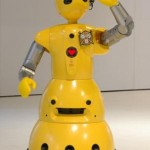
 If robots have largely proven their ability to replace humans in the industrial field, where they perform tasks without flinching the most menial or repetitive more rigorously, we reserve the robotics still nice surprises in the field of business. Around the globe, teams of researchers working to demonstrate that both a priori overcome, the machine is often able to supplement or even replace humans. Continue reading
Monthly Archives: October 2009
The first festival of robots in Mantes-la-Jolie
 Robotics and Mechatronics will honor the first festival of robots for the general public, academics and professionals. A rally around the robot through the robot competitions, conferences and workshops, exhibitions and entertainment. This national gathering, an initiative of Mantes-la-Jolie, aims to raise public awareness of robotics and its integration Continue reading
The CNRS, guardian of robotics
 Humanity is at the dawn of the robotics era. The final verdict is that of Philippe Coiffet, one of the founding fathers of robotics in France, now director of research at the CNRS Laboratory Robotique de Versailles (LRV) and writer. However, significant scientific advances of this major emerging discipline has undergone major changes. Continue reading
SpaceCat: The Stepping Triple Wheels Robot
Motivation
- Mobile robots are of highest interest for unmanned planetary exploration
- The European Space Agency (ESA) is seeking for innovative micro-rovers for future missions to mars, moon and other planets
- Human guided mobile robots have a high potential also for various applications on earth Continue reading
SmartROB-2
 The SmartROB is used by Prof. Siegwart and Dr. Buhler at the ETH Zurich for the course “Smart Mechatronic Product Design”. It gives the users a versatile, high-level mobile robot kit suitable for a wide variety of tasks. The SmartROB-2 contains all features necessary to drive several DC servo- or stepper motors up to 100 W per channel in addition to a number of uncommitted analogue and digital inputs and outputs. Continue reading
Pygmalion: A New Mobile Robot
Design Principles
 Computers stay normally where they are. Man-machine interactions depend thus only on the part of the human being. On the other hand, autonomous mobile robots have a radically expanded work space, shared with that one of human beings. It enables them to initiate an interaction by themselves. This gives rise to a new kind of man-machine interactions under circumstances which would not have happened otherwise, for instance with people without technical experience. It is therefore desirable to design mobile robots in a deliberative way, keeping their appearance friendly, decent and not dangerous. Continue reading Computers stay normally where they are. Man-machine interactions depend thus only on the part of the human being. On the other hand, autonomous mobile robots have a radically expanded work space, shared with that one of human beings. It enables them to initiate an interaction by themselves. This gives rise to a new kind of man-machine interactions under circumstances which would not have happened otherwise, for instance with people without technical experience. It is therefore desirable to design mobile robots in a deliberative way, keeping their appearance friendly, decent and not dangerous. Continue reading |