Cyber Dyne Company decided to start mass production of exoskeleton. Apparatus HAL [hybrid assistive limb, or “hybrid auxiliary limb], designed to increase the physical strength of the owner. Using sensors attached to human skin, exoskeleton determines which muscles are going to involve people, and creates a directed effort. For the same reason people do not feel the weight [25 kilograms] of this suit. Continue reading
Quadruped robot LittleDog improves the skills
While Big Dog runs field trials (see note “Carrying loads on the four-legged walking robots”), His little brother – Little Dog – improving their skills in the laboratory. Both the robot was developed by Boston Dynamics, working on order of U.S. Advanced Research Projects Agency of the Ministry of Defense (DARPA) and was originally intended for use by the military. Continue reading
Geminoid-F – the girl-robot with human facial expressions
Japanese Professor Hiroshi Ishiguro and Robotics (Hiroshi Ishiguro) first became known to the public through the creation of his “twin”, the robot Geminoid HI-1. Remote-controlled, he was able to convey basic emotions of its operator and transmit his voice with built-in speakers. The main purpose of this robot was to study the various psychological aspects of the interaction of robots and humans. Continue reading
Carrying loads on the four-legged walking robots
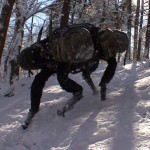
The company Boston Dynamics is widely known in the robotics market due to its successful invention – enduring four-legged Big Dog. This robot is the size of a large dog to become a good help the soldiers, Marines – it can be controlled, he should go where to the right, and thus carries a payload of up to 136 kg over a distance of 20 km at 6 km / h. Continue reading
Robot spider with artificial intelligence
Matt Bounding, a student at the University of Arizona, developed and built a robotic spider that automatically learns to walk whenever it include. The robot is equipped with a webcam; it analyzes the image and comparing them with the movement of their own feet, learning to walk. Continue reading
Human-Robot Interaction of The World
Tactile, acoustic, and vision sensors provide robots with perceptual capabilities, enabling them to explore and analyze their environment in order to behave more intelligently. The intelligent robot system KAMRO uses several camera systems to generate an environment model in order to perform complex assembly tasks. Continue reading
The Intelligent Mobile Robot KAMRO
Higher intelligence and greater autonomy of more advanced robot systems increase the requirements for the design of a flexible interface to control the system on different levels of abstraction. In the Kamro (Karlsruhe Autonomous Mobile Robot) project, for example, an autonomous mobile robot (Fig. 1) for assembly tasks is being developed which also has the capability of recovering from error situations Lath and Remold (1994). Continue reading
Ultrasonic Range Sensor
This is the Devantec SRF-04. The tiny package easily mounts to your small robot. It is assembled using surface mount technology. Requires soldering wires to the module. Continue reading
IR Proximity Detector Sensor
This is the “no contact” obstacle detection system. The range is adjustable from 4″ to 26″. It is assembled using surface mount technology. Plug and Play with the Mini Atom Bot Board microcontroller. Continue reading
Give Intelligence to Robots
How to give intelligence to robots? The servants of the future must be reliable and competent for the tasks to be performed. We should be able to fully rely on them.
The robots can become more intelligent by asking for help
A company in Palo Alto believes that the best way to make intelligent robots, they would seek help to humans. Continue reading