
 Humanity is at the dawn of the robotics era. The final verdict is that of Philippe Coiffet, one of the founding fathers of robotics in France, now director of research at the CNRS Laboratory Robotique de Versailles (LRV) and writer. However, significant scientific advances of this major emerging discipline has undergone major changes. Continue reading
Category Archives: Robotics_Research
In the secret laboratories
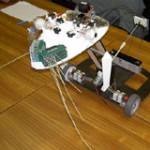 Among the amazing robots being prepared in secret labs French must include Psikharpax, which works on the Lip6 (Computer Lab Paris 6).The mobile robot that looks like a mouse – its “head” ends with a dart nose where long whiskers – will be released in an unfamiliar environment where he must survive. He will remember the important places where recharge his batteries and those where he runs a risk – there heard footsteps – to better avoid them, and will plan its tasks according to the constraints. Continue reading
Radius’ robotic entertainment
 Everyone knows Aibo, although few copies of this amazing animal has been purchased in Europe. For a few thousand euros, the robot designed by Sony mimics the behavior of a small dog which he reproduced the brisk walking and attitudes. He knows how to play with a bone, a dance, respond to your caresses, recognize your voice and even go to recharge electric power alone. Continue reading
Pygmalion A New Mobile Robot
 Design Principles
Computers stay normally where they are. Man-machine interactions depend thus only on the part of the human being. On the other hand, autonomous mobile robots have a radically expanded work space, shared with that one of human beings. It enables them to initiate an interaction by themselves. This gives rise to a new kind of Continue reading
The face becomes the remote control robot

The University of San Diego wants to maximize their likely future interactions between students and teachers robotic. The goal: to have a robot that pace in its current function of facial motion of its audience
Facial expressions should be able to control the behavior of a robot. Jacob Whitehill, a researcher at the UC San Diego School of Engineering, works in the remote control of a video sequence showing the course depending on the degree of understanding of students. The project in the idea that future teachers robotic systems could be developed. The long term goal is to make robots better teachers. The project is based on technology of facial recognition. Thus, Jacob Whitehill has shown that the information given by our facial expressions while watching videos help you understand whether or not the explanation which is filmed. Continue reading
The robot is captured by the sign language

To understand the intent of others, the robot can rely on their movements. One way not to go through traditional means of communication and make more autonomous machines.
By programming robots to recognize their left and right, a team of Franco-Israeli would also enable them to communicate through the movement, like the bees. To achieve this, they are based on a communication solution called implicit stigmergie. It allows interaction without exchange of data: if the robot starts to the left the other responds in a way, to the right of another, etc.. The purpose of this research, published in the article “Deaf, Dumb, and Chatting Robots,” is to build machines that can transmit information even in case of failure of their traditional transmission systems. Continue reading
Johns Hopkins Robotics
The Laboratory for Computational Sensing and Robotics (LCSR) is an interdisciplinary academic center at the Johns Hopkins University.
The mission of LCSR is to foster innovative robotics science and engineering research.
Located in Computational Science and Engineering Building (CSEB) at Homeweood campus (Baltimore, Maryland), this unique two-story laboratory is one of the largest and most technologically advanced robotics research centers in the world.
The concept – Nao Robot
 The project was launched in early 2005 and aims to make available to the general public at an affordable price, a humanoid robot with mechanical functions, electronic and cognitive worthy prototype research (see chart below). Nao should be available to the general public at the end of 2009.
Comes standard with basic behaviors, the robot will be marketing the ideal support to learn robotics and enriched many behaviors, it will become an autonomous companion for the whole family. He later evolve its role as a companion to a real job assistance for daily tasks (monitoring, tele-assistance, information, real-virtual link …).
Continue reading
Bionic Wasp Israeli Robot
The State of Israel is using nanotechnology to develop a robot no bigger than a wasp to be able to hunt for targets, photograph, or even kill them …
This killer application of science s’apellera “bionic wasp. It will be able to navigate through narrow corridors to target enemies, generally inaccessible, such as rocket launchers.
It is in fact a weapons developed in time by the Israeli authorities, in order to fight “terrorists” (heard here “all those who do not follow the diktat issued by governments). Other weapons are planned, such as gloves that will lift heavy loads.
Continue reading
A robot for beginners but also for experts
ASURO is a small mobile robot fully programmable in C that was developed in a high school robotics in Germany.

For electronics experienced assembly is a breeze. For others, the experience of the weld is still required. With the exception of circuit boards, all components are standard commercially available.
The programming is done only with freeware. ASURO is ideal for technical enthusiasts who want to start circuits controlled by a processor, research projects, training courses or evening classes for adults.
Continue reading