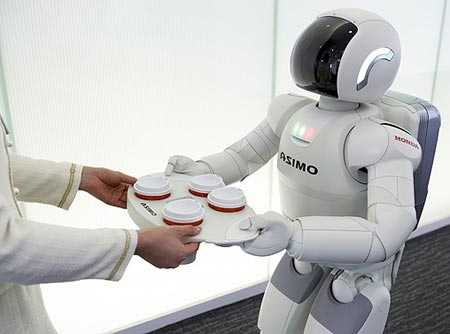
The robots in action in Japan

The Japan concentrates 40% of the nearly 923 000 industrial robots on the planet. It is not surprising therefore that the country is regarded as the kingdom machines. The trend is now for service robots designed to assist a Japanese population ageing.
Heroes manga (comic books) or animated films, industrial or humanoid robots serve as technology showcases the major national groups: the Japanese robots to display a genuine enthusiasm. Currently, all eyes are turning to robotics service in a variety of fields: submarines, medicine, cleaning, security, fisheries, forests, health care, recreation and pets. A segment which, if it remains marginal, is nonetheless promised a bright future. The 2007 International Robot Exhibition to be held in November in Tokyo, had planned to devote more than a third of its programme. The International Federation of Robotics (IFR), based in Paris, distinguishes between two types of non-industrial robots: those for professional use and those for private use. It is estimated that 31 600 units of the first category were commissioned in 2005, of which 18% robot submarines, 17% of cleaning robots and 16% of robots defence / security. Although increasing numbers of robots for private use are also much cheaper. Of the 2.9 million machines of this type listed by the IFR, more than half (1.8 million) were vacuum robots such as “Roomba” by the U.S. firm robot, 1 million robots games and Leisure and about 79 000 robot lawnmowers. According to Marc-Antoine Haudenschild, a specialist in Japan serving Global Equity Research at Credit Suisse, “service robots are only in their infancy. Continue reading

robots also feel pain

SimroA Japanese company offers a humanoid robot for training future dentists.
Getting treatment for a bunt is never a pleasant thing for anyone and the dentist must be taken into account in improving its technical intervention to relieve his patients, including those for which the rumble of the famous strawberry gives sweats cold.
In order to train future dentists to treat properly cavities while guaranteeing a minimum of pain for patients, the Japanese company Kokoro created a robot named Simroid. Presented on Wednesday in Tokyo, Japan, it is a humanoid robot in the form of a woman measuring 1.60 metres, with long hair and was wearing a pink sweater and pants white. If it badly during the intervention, Simroid can verbally express his pain or froncant eyebrows like a real patient. A sensor was also placed on the chest of the robot, to detect any gesture displaced students. Continue reading

Humanoid robots more intelligent

Des robots humanoïdes encore plus intelligents In 2005, Honda launched its latest humanoid called Asimo. Since then, the Japanese manufacturer focuses on improving the intelligence of these robots. And it works.
The faculties of communication and autonomy of Asimo have increased. They are able to decide on the choice of their tasks and know when they must recharge their batteries. In communication with other Asimo present in the vicinity, the robots will divide the tasks, are experiencing levels of batteries each and share information on their future work. Continue reading

Latest humanoid robots in Bielefeld

will be inaugurated at the University of Bielefeld, the Institute of cognition and robotics (Cor-Lab). Thus, strengthens an already well-established cooperation between the university and the Honda group. It will provide researchers at the institute for the first time in Europe, two of its new humanoid robots “ASIMO” and will support financially positions of doctoral students in the framework of joint projects. The ASIMO is considered the humanoid robot biped most modern in the world.
The institute will carry out its research activities in the area of cognition and intelligent robots “, a scientific field in which groups of interdisciplinary research at the University of Bielefeld are distinguished, nationally as internationally. Continue reading

One of the robots bipedes the most advanced in the world

For the development of movements of ASIMO, Honda has studied
and used as a model coordinated movements
and complex human body. The proportions and position of the joints of ASIMO resemble those of a human being and, in many respects, the robot has a range of movement comparable to ours.
Using a new advanced mobility system developed
Honda, ASIMO can not only move forward, backward,
but also to move sideways, up or down stairs and turn in walking.
In this regard, ASIMO is the robot that imitates the movements better
Walking natural human beings. Continue reading

The robots exhibition

In 2000, based on experience with P3, Honda presented Asimo (Advanced Step in Innovative Mobility), a robot exhibition represents the culmination of 14 years of research. It was designed under the direction of the engineer Masato Hirose. This small autonomous android measure 1.20 meters and weighs 53 kg. It moves at 1.6 km / h but it is capable of running a moderate pace (12 kph), skipping, dancer and ascend or descend stairs. Admittedly, sometimes it even rate a march through the public representation, but we do so, the difference qu’Asimo can not even stand up alone.
But although it is a robot, and see the warning, showing signs of intelligence and then dropped onto a trap and be unable to recover any revealed the impotence of men to inject life and reflexes fundamentals. At the same time fascinating and pathetic, he fell on the stairs revealed how much was still a long way towards creating a completely autonomous android. Continue reading