
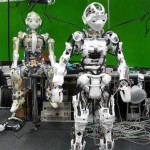
 (NC & T) Humanoid robots today can walk, but can not interact with the world. Khatib and his collaborators are working to develop robots with the capability to physically touch, push and move objects. Continue reading
Category Archives: Robot worldwide
Hyper Line Tracker Robot Kit
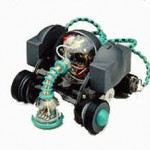 This cyber bug has a line tracking system and it is fortified with a multitude of sensors. Phototransistors enable it to detect a black line, and tracking memory allows it to memorize its last track of the black line. Continue reading
Moon Walker Robot Kit
 Moon Walker II has combined the technology of two sensors. It begins to walk when it detects a change in light intensity or sound commands. Moon Walker II continues it’s four legged voyage until instructed by an internal timer to stop. This kit presents an engaging opportunity to learn about some of the mechanics, operation and history of robots. Continue reading
Robot already have than to digest and there than to chew

Originally, the custom, that a robot – it is an imitation of man. What really
surprised when scientists using robotic devices are trying to imitate human
organs. This is not about prostheses, namely the simulation of human organs for
medical research. Recent advances in this field – robotic jaw and … stomach
Preoccupied by the creation of a robot-gastric scientists of the Institute of
Food Research in Norwich. On the creation of a dynamic robot models of human
gastric they took about 10 years. The artificial stomach to help researchers
study the process of human digestion. In robotic stomach will be tested and new
drugs.
Earlier in the summer of last year the public was provided with the development
of scientists from
University of Bristol. They managed to create a robotic model of human
masticatory apparatus. At the heart device is a three-dimensional model of the
oral cavity, equipped with mechanisms to six linear drives and imitators teeth.
The device accurately reproduces the human jaw movement and because of their
compression.
With these robotic jaws planned to experiment with new materials for the
dentist. Dentists calculated using robotic models of the jaws to stimulate
research in their field and, ultimately, make treatment of dental diseases more
effectively.
So that progress in gradual robotic human organs can not be doubted. Robota has
got something to eat and even what there is to digest …
Mujiro and Ligurio Robotics
 This is quite futuristic robot TMSUK company has two models Mujiro and Ligurio, seem to differ only by color (purple and blue) of their war paint. Continue reading
Tin Can Robot
 This interesting kit allows a robot with a can of soda.
The robot is very simple, a motor, a pair of wheels … but very curious.
Of course for the price (about 10 euros) is a good gift for someone who likes robotics.
Once assembled, with a battery and a can of soda that are not included in the kit will move forward and spin like crazy.
The Leonardo da Vinci robot
 In 1950 they found some notes from Leonardo Da Vinci on the construction of a robot very similar to what we now know by robot. The notes are dated in 1495 and since then you can see in advance what was Leonardo Da Vinci of his time.
The robot consists of a truss Germany and Italy and an internal mechanism with which it is assumed that performing human-like movements.
Robot hand with tactile sensors
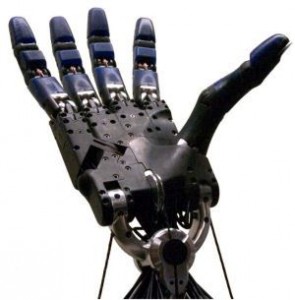 The new Touch Sensor Company “Shadow Robot Company is the nearest robot to the human hand that has been created. It provides 24 movements, allowing direct mapping of a human to the robot.
Robotic Hand “Shadow Robot Company has integrated sensors that allow precise control of the orders from a deck, this thanks to 40 Air Muscles which make it move. The muscles are so docile, allowing it to make soft or fragile objects. Continue reading
Evolutionary robotics
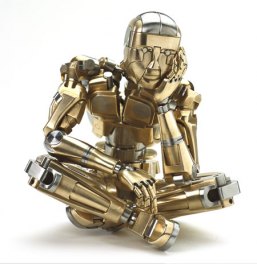 The Evolutionary Robotics (ER) is an area of autonomous robotics, in which drivers are developed through evolution robots using genetic algorithms.
It usually evolves Neural Networks as it follows the reference biological and simplifies the design and representation in genetic algorithm.
The foundation of the RE is relationship to work at the CNR in Rome in the ’90s, but the initial idea of encoding the control system of a robot in a genome and evolutionary data of the 80 late. Continue reading
Developed a humanoid robot
 JST (Okimura Noriki president), the child’s body size, flexible joints throughout the body (51 air actuators use of moving parts locations) and soft skin (the skin around the bottom of the 200 pieces of silicone provide tactile sensitivity tactile sensors throughout the body) of a humanoid robot with unprecedented features “Child-robot with Biomimetic Body (CB2)” was developed. Continue reading