

Mars it is the most Earth-like of the nine planets that make up the solar system. The great distance from Earth (400 million km from the Earth at the farthest point of its orbit) makes travels to Mars long and dangerous. Hence its exploration has been so far carried out only by robotics means. Thanks to its similarities to Earth (i.e. a solid planet with atmosphere), Mars allows the use of the most diverse robotics means:
-Penetrometers and Robotics Moles for underground exploration
-Rovers (tracked, wheeled or legged) and hoppers for surface exploration
-Aerobots (balloons, blimps, planes and hoppers) for aerial exploration Continue reading


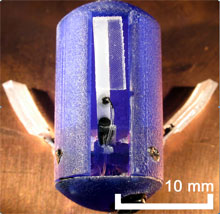 The nano robotics laboratory at the University of Carnegie Mellon has developed a new type of robot that can be swallowed and controlled outside the body. The capsule has a small robotic arm adhesives that can be set on internal walls slippery and then come off without damaging the tissue. Using a remote control, doctors can tell the robot when out or retract his “legs” in order to fix or detach. Once ingested the capsule as any conventional pill, it can be used to take pictures of areas necessary, or make mini-films through a mini-camera, but it could also have other features, such as dissemination of a drug, tissue, or cauterization wound with a mini-laser, or other applications ..
  I-Sobot is the name of this tiny humanoid robot. I say very small because these dimensions are 16.5 centimeters high and 6.7 centimeters deep, 10 centimeters wide and 350 grams. With these I-17 engines Sobot is capable of reproducing 200 movements including dances, imitations of animals, acrobatics and galipettes complex and may deliver approximately 180 words. Other good news this humanoid that can be controlled through a remote control and a dozen voice commands also have a Wi-Fi connection to the I-SOBOT CAM Version which will drive the distance helped by a camera built into its head.