
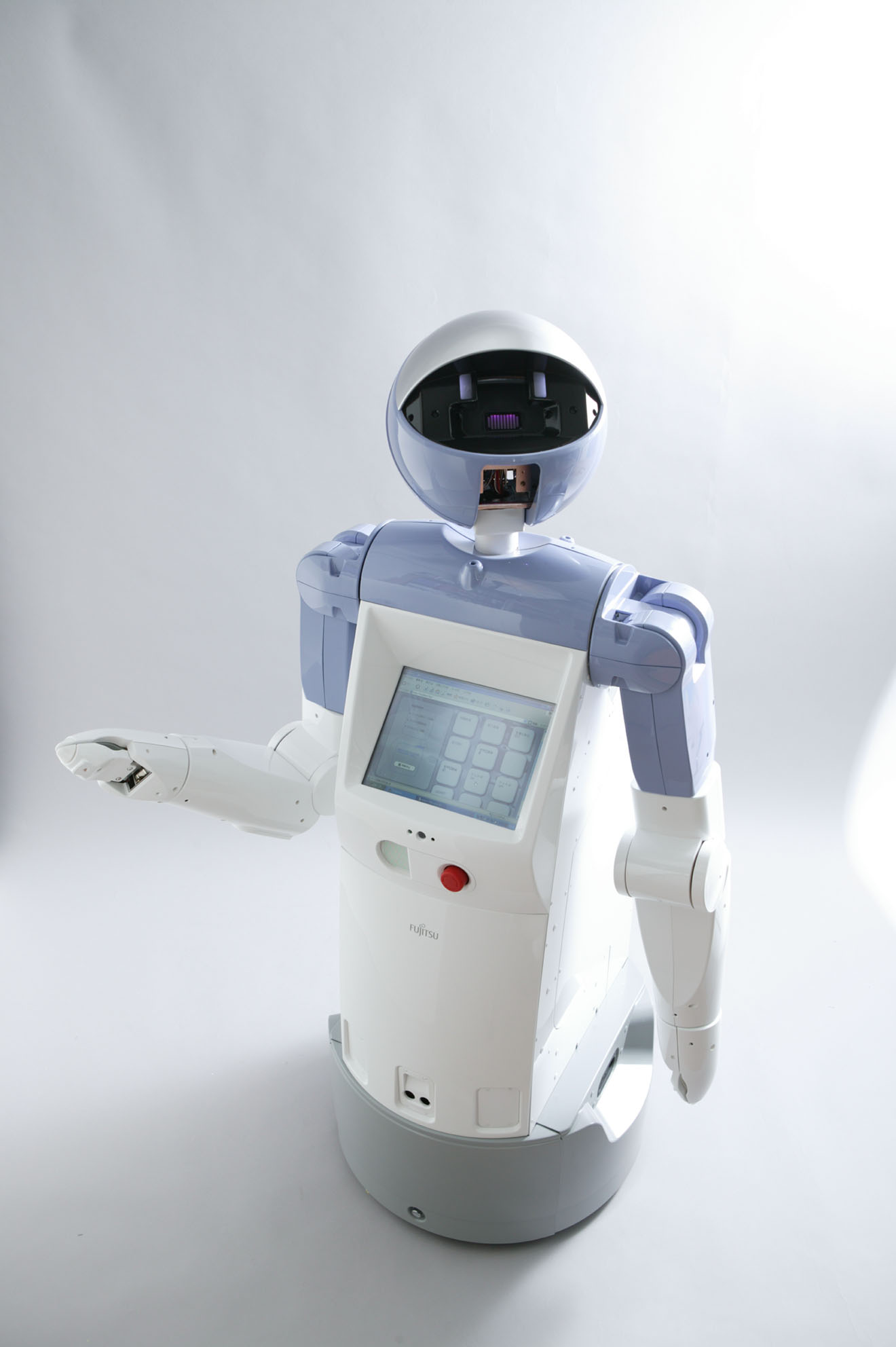
 In the USA, most federal agencies support programs in robotics. For example, with NASA missions and Sojourner Martiennes, NSF whose various programmes display thematic Robea, mainly in the division CISE ($ 190M budget in 2001), or DARPA. Most American universities have teams and laboratories in the field (particularly those referenced on this site), like the Robotics Institute of Carnegie-Mellon University, which concentrates more than 200 researchers in 25 projects ranging from exploration or planetary polar driving. It should be pointed out effort R & D industrial robotics in the USA. Thus the work of CMU develops and builds on the Robotics Consortium Pittsburgh.The Japan mobilizes ambitious projects in the field. The program launched in Humanoid Robot 98 (50 million over 5 years) is significant research efforts of this country, efforts that extend through activities of industrial R & D intensive (Sony, Honda, etc). Continue reading
Tag Archives: robot
Time-scaling control for an under actuated biped robot
 This paper presents a control law for the tracking of a cyclic reference trajectory by an under actuated biped robot. The robot studied is a five-link planar robot. The degree of under actuation is one during the single support phase. The control law is defined in such a way that only the geometric evolution of the robot is controlled, not the temporal evolution. To achieve this objective, we consider a time-scaling control. For a given reference path, the temporal evolution during the geometric tracking is completely defined and can be analyzed through the study of the dynamic model. Continue reading
A new office assistant robot designed by Hitachi
 The group diversified Japanese electronics Hitachi introduced Wednesday a new robot designed to assist employees in offices and to replace the hostesses to make a green tea to visitors, through its faculties of communication and travel.
Called “Emiew 2”, this humanoid robot red wheels, 80 inches tall, is the descendant of Emiew, a first version designed by Hitachi in 2005.
“Emiew 2”, which includes 27 degrees of freedom (joints), is lighter than its predecessor (13 kg instead of 15 kg).
The robot assistance, designed to “cohabit with humans, is able to move independently at a speed of 6 km / h, even a human pressed. He can communicate by voice recognition and knows how to move within a company through a radar to bypass obstacles, and a map of places he could establish himself. “We will continue research and testing to ensure that in future robots can perform tasks in businesses, as visitors guide or carry out surveillance round,” said Hitachi. Continue reading
Asimo 2: New version of the humanoid robot

Honda has released a new version of its humanoid robot Asimo. This version is not fundamentally different from the previous one, but nevertheless provides significant improvements in the capabilities of the robot.
The best short (two times faster, or 6 km / h, but more importantly being able to follow a curve or slalom ant between plots). It is accompanied by new sensors, enabling it to better recognize its environment, or to hold a human hand in adapting its movements and displacements. It may finally seize objects and transport, maintaining his balance and adapting is also necessary force permanently. Continue reading
A robot controlled by a mold

Through a rather simple equipment, a giant amoeba command the movements of a six-legged robot. Perspective: draw some manufacturing secrets that will one day be useful to robots.Quand the robot to six feet away from itself a source of light placed nearby, it does to any software or even a network Neural. The pilot is… a mold! More precisely Physique polycephalum, a strange organism in forests under the fusillades. This nice six-legged robot moves systematically light. However, no programme and no human would command him to do so.
This kind of yellowish giant amoeba, which is usually a few millimeters but may reach thirty centimeters, eats bacteria and small mushrooms. It has no legs and no body. All the cells were merged into a single plasmodia. Biologists rank among the myxomycetes, along with a few zoological curiosities hardly classifiable or plants or animals.
In short, this modest living being is nothing that can make it the ideal driver for a hexapod robot. Yet the role that made him played Klaus-Peter Zauner, Department of Electronics and Computer Science, University of Southampton (United Kingdom), in collaboration with a team from the University of Kobe, Japan. The driver, it’s him! This Schumacher Car hexapod is a kind of mold inform, moving like an amoeba. Continue reading
A robot bats revive research on sonar

A robotic head of bats capable of transmitting and detect ultrasound in the band of frequencies used by bats in the real world will give an important impetus to research in the field of echolocation. “Bat – Bot “, developed under the project CIRCE of the IST (Information Society Technologies) may also stir ears, technique often used by these animals to modulate the characteristics of the echo.
CIRCE developed the Bat-Bot to mimic more closely at the amazing qualities of echolocation in bats. “The sonar in water is an area controlled, but studies on a sonar air are much less advanced,” says dr. Herbert Parmesans, who heads the laboratory of active perception of the University of Antwerp and CIRCE coordinating the project. “Wherever roboticiens want to build an autonomous robot, they deal primarily the sonar, but they quickly encounter problems due to the nature too simplistic devices of commerce, and then spend the visual systems or laser. We hope that our research on the bat robotic systems will lead to more sophisticated sonar useful for robot navigation and other applications, “he says.
One of those potential applications could be identifying plants by echolocation. Continue reading
Toyota entrust the keys to his museum to a humanoid robot
 A new humanoid robot will serve as a guide loquace in the museum’s first automobile manufacturer worldwide, Japanese Toyota, inside his stronghold in central Japan.
Presented Monday, the robot to look feminine, with a height of 1.20 meters with a weight of 60 kilos, moves independently on wheels, avoiding obstacles.
Called “Robina”, it will guide visitors to the museum Automotive Group-Toyota City, near Nagoya (center).
According to its designer, “Robina” is capable of giving explanations to watching a person who recognizes the name on a badge. It can also keep a pen and sign autographs willingly, promised Toyota.A like his compatriot and Honda with its advanced technologies, Toyota has been actively engaged in the development of robotic technologies, convinced that the robots will in future play an important role in the aging Japanese society. Continue reading
ASIMO the robot who leads the Detroit Symphony Orchestra
 ASIMO, robot high of about 130 centimeters and developed by Honda Motor Co., has lead his first symphony orchestra in an interpretation of The Impossible Dream, from Man of La Mancha. From his voice child, the robot was sent to the public with a “Hello World”, before assuming his duties at the desk of the conductor. Continue reading
The little robot at Aldebaran Robotics
 The French company Aldebaran Robotics working since 2005 to develop a robot biped for the general public. The small humanoid named NAO is very promising since board functions mechanical, electronic and cognitive worthy of the best research prototypes! You can really see it as the little brother of the famous Honda’s ASIMO. Thanks to its integrated web cam is able to perform facial recognition. NAO is therefore able to identify a caller and respond to him through a speech synthesizer function. It also loads a wireless connection type Wi-Fi allowing a remote control robot (possibility to access the images captured by the web cam board). The robot is able to distribute content via its integrated speakers (MP3 playback by the network, reading mails…) It depose also understandable hands enabling him to take some objects. Nao top of its 57 cm (4Kg) is able to move and can operate autonomously for 1 to 3 hours depending on the number of times or you soliciter. This robot will be delivered by default with basic behaviors that will make a perfect companion for the whole family. But NAO is also a superb scalable platform that revere all passionate technology and programming. It will be possible to develop new behavior and to learn many interactions through URBI.URBI language is a Universal Interface for Interactive Systems (Universal Real-time Behavior Interface), which lets you control robots or interface games videos with a powerful scripting language. Continue reading
The small humanoid robot takes shape

A few months ago, I presented Nao the little robot at Aldebaran Robotics at the time it was forbidden to distribute photos or videos of the prototype but today things have changed. Now Nao is the day star, it is everywhere! It was thus seen make his first major public out at the last Fanny’s Party and the chain TV shows (see video later). Nao is a true technological marvel that has many device allowing him to interragir with its environment. It loads gcc a facial recognition system but also object. His speech recognition system is eglament impressive. For example, you can give the order “Read me my emails” and the robot through his speech synthesizer makes reading a few moments later. The most critical find that Nao is pale figure facing Qrio Sony or Honda’s Asimo, but we must keep in mind that this is not at all the same range. The robots from Sony and Honda are prototypes expirimentaux the coup astronomical (40 000 euro minimum the robot) while Nao is intended for the general public. Continue reading