 Aided by humans, they mutate and improving. The theory of evolution will it one day apply to the PLC?
They had to revolutionize the world, invade industry, to interfere in the slightest interstices of our daily lives, before turning into higher beings … There is still nothing. When, in October 1950, Alan Turing published in the journal Mind an article in which he raises the question-fetched: “The machines can they think?”, It stirs the wildest predictions. Test to support, the famous mathematician replied in the affirmative and Their appearance around … 2000. Today, the intelligent robot passion always the same. On 27 June, the symposium organized by the Group of prospective Senate, and sponsored by Express, show the abundance of research and hopes will point the most serious. Continue reading →

 Nuvo, the walking robot of Japanese ZMP, will be offered for Christmas at a price of $ 4,600.It measures 15 inches, walking on two legs, is if it falls, and may dress in several colors. But look no similarities with his colleagues under development at Sony or Honda, which look like humanoids whose marketing is not yet valid. Car Nuvo is its name, has no head so that they can more easily maintain a balance. Likewise his arms were reduced to its simplest expression, with balls without fingertip instead of mains. It responds to simple voice commands, like “advance” or “stop” and can be driven remotely ‘ Using a cell phone. Continue reading
  Last week, Professor Oh Jun-Ho was sacred “Man of the Year 2004” at the Institute of Advanced Sciences and Technologies of Korea (Korea Advanced Institute of Science & Technology, KAIST), including its work on humanoid robot. He met in recent days to an interview published on Oh My News, in which he explained the specific characteristics and challenges of humanoid robot Hubo. Hubo is a direct competitor Asimo, the robot developed by Japanese Honda: a comparable size (120 cm), it may evolve over two legs, shake hands or carry out specific tasks. One of its main specificities is to have hands with each of the fingers are independent. But the father of the robot can boast especially the speed with which it was developed (two years) and the related budget: “In fact, it may take more than $ 500 000 were invested in this research,” considers Jun-Ho Oh, and although the total budget is usually estimated at one million dollars, it is far from the $ 300 million spent on a Honda Asimo over the past 10 years. “I do not think Hubo is higher than Asimo. This is incredible and deserves our respect.
  The robots experiencing emotions are a good topic of science fiction, and a Holy Grail for researchers intelligence artificially. Mais machines equipped with a different kind of feeling, the sense of touch, may emerge soon. The results of a new study represent a significant advance in this direction. Scientists have developed a flexible artificial skin sensitive to pressure and temperature.
 This year’s football World Cup “RoboCup” takes place in Germany from 14 to 20 June 2006. The competition generated by the “RoboCup” should encourage research in artificial intelligence and the robotique. In Indeed, this initiative “RoboCup is an excellent way to assess the progress made in robotics. For Ubbo Visser, organizer of the competition and a doctorate at the University of Bremen, football offers the best challenge to robotics: “it is a very dynamic situation where the systems must react to the thousandth of a second. robots work in real time, must be totally independent but must also cooperate with their partners. In addition, they are opposed to competitors who try to destroy their strategy. ”
  The Japanese Honda, in particular specialized in industrial robots, has demonstrated the use of a scanner for magnetic resonance imaging (MRI or magnetic resonance imaging) that detects brain signals and transmit them to a robot in order to drive Hand artificially. Lorsque the person in the MRI has waved his hand and made the sign ‘V’, the robot’s hand movements has reproduced! The system is still limited to the detection of a few simple gestures, and it will take time before being decoded complex movements. Similarly, we have to evolve singularly PMI technologies to reduce the size and weight. However, the “brain machine interface ‘, the interface between the human brain and machine, developed by Honda Research Institute Japan, opens up new perspectives.
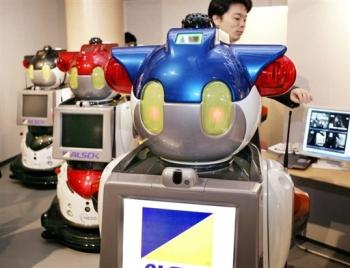
 The Japanese electronics company Hitachi has presented today the new model of the robot designed to help office workers in their tasks. Petit humanoid red and white measuring 80 centimeters (31.5 inches) long, 2 Emiew moves through rollers beneath his legs. It is intended to replace his predecessor Emiew released in 2005. From a weight of 13 kg (15 kg for Emiew), Emiew 2 is composed of 27 degrees of freedom (joints). It can travel on an autonomous basis at a speed of 6 km / h (a human pressed moves at that speed). The robot is also equipped with a gyrosenseur allowing it to keep in balance. It also has a laser radar enabling it to map its environment. It can also avoid obstacles on the size of human him block the road. Finally, Emiew 2 is able to understand human language. During the demonstration someone asked where a person was sitting.